Cat’s Customs is a student-led small business that customizes clothing, signs, stickers, accessories, and more. Cat’s Customs was established in 2022 and can buy its products at the high school student store and on its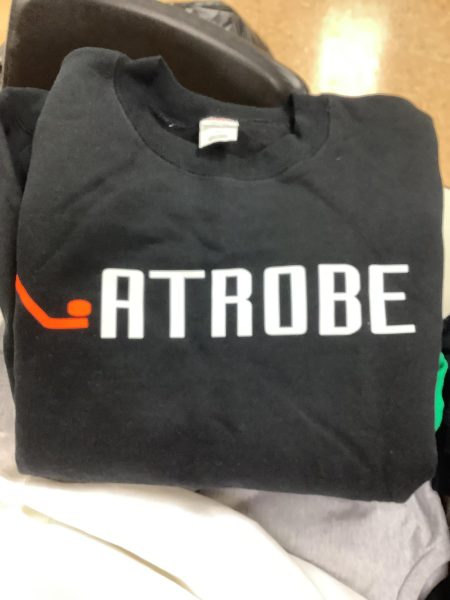 online store. Students can take the class in Greater Latrobe High School, and that’s where they make their items. One student who takes the class, John Massaro, loves that the class is hands-on. “Being able to work on things that aren’t paper, pencil, or on the computer makes the class fun,” says John.
Cat’s Customs produces an impressive array of items. Mrs. Butler noted that the team sells “…a lot of apparel. T-shirts, long sleeve T-shirts, hoodies, crewnecks,” which she described as “probably the biggest volume of what we sell.”
Beyond clothing, the business handles numerous specialized projects. Mrs. Butler listed custom mugs, vinyl applications for Yetis and Stanleys, wedding items such as bridesmaid hangers and table numbers, acrylic laser-engraved tags, stickers, signs, banners, dog bandanas, baby apparel, and more. She remarked, “We’ve done so many different projects.”
Recently, they even expanded into embroidery after receiving a grant. “We just started using our new embroidery machine,” said Butler.
Throughout the years, the business has taken on several large-scale orders. Mrs. Butler recalled printing

shirts “for the entire freshman class… about 300 pieces,”
The Greater Larobe Education Association was “close to 300 pieces as well.” She also mentioned that while some projects are large in quantity, others are significant because of the detail involved. These experiences demonstrate the broad range of skills students gain in production, organization, and customer service.
One of the most unexpected challenges the program faced occurred during the summer, when mold was discovered in their original workspace. “Mr. Marker discovered it… I was actually at the beach at the time and got a phone call from him,” Mrs Butler explained. Because their equipment is expensive and their inventory extensive, the discovery was alarming.

She shared that the mold was found “at the end of July,” and her immediate concern was “the amount of equipment we had in there and the monetary value attached to that.”
Fortunately, the district responded quickly. As she described, “They moved very quickly to expedite getting all of our equipment out of the room… that was what was most important.” Most of the inventory had already been bagged, so little was damaged. Still, the displacement created new challenges.
The temporary room assigned to Cat’s Customs was much smaller and far less functional. According to Mrs. Butler, “It was considerably smaller with much less storage space… we had to be careful where we plugged things in because we were blowing fuses.” She added that the constant electrical issues meant frequently inconveniencing the maintenance staff, “We had to continually inconvenience George, and it was not ideal.” The cramped layout made it difficult for students to move around and work efficiently, disrupting the system they had spent years refining.
They returned to the original space in the lower H hallway after the mold was dealt with. After returning, there was a huge sense of relief. “Yes, 100%,” she said when asked if she preferred being back in the original room. She explained that the space offers far better organization, storage, electrical reliability, and workflow for the students. “It’s great… the storage space is very adequate, and it keeps us much more organized.” She also emphasized that the improved environment benefits students directly, “It’s just a much better working environment for our kids.”
 Even now, with a stable workspace, managing workload remains a challenge. Because Cat’s Customs is well-known and accessible, many people in the district reach out for custom work. The teacher admitted, “I tend to take on almost anything that people ask me to do, no matter how busy we are.” However, the class meets for only 90 minutes every other day, which limits production capacity. As she explained, “People don’t realize it’s harder to turn things around… we’re not an 8-to-5 business.” Balancing demand with quality and time constraints requires constant awareness and organization.