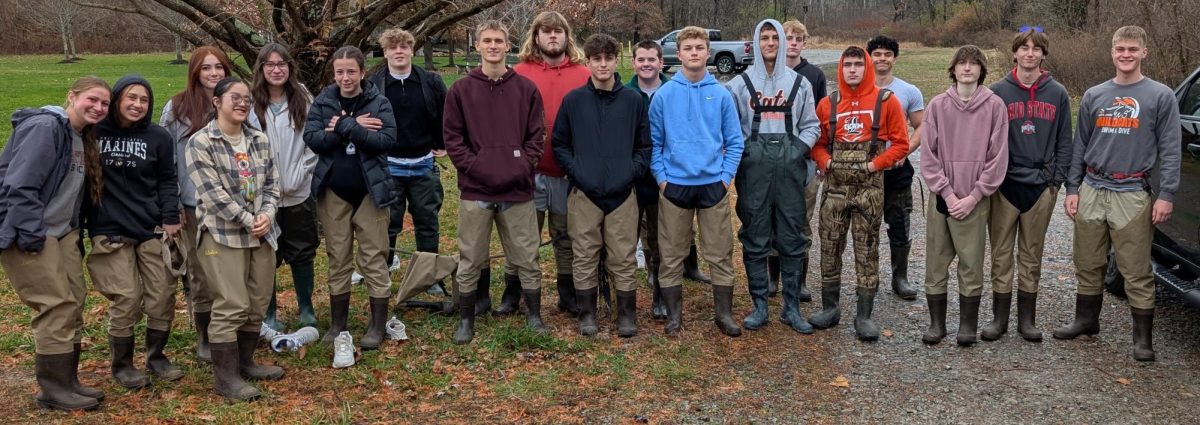
For thirty-one years, the Greater Latrobe High School has offered the Capstone class to senior students. The class was established in 1995, and when it first started, the teachers were Mr. Harvey, Mr. Brandt, and Jim Dimuzio. The current teacher is Mr. Roberts, who has held this role for four years.
Mr. Roberts’s passion was to teach biology. “As a kid, I was always outside and always enjoyed nature. So it’s really nice to be able to share that with kids and share experiences that they wouldn’t get to do normally,” said Roberts.

This year, they have been focusing on bringing science to the elementary schools. Senior Lauren Bonazza-Shaw said her favorite part of the class is “when we go out and do things like going to elementary schools.” The class took the bass they caught to first grade, where Mr. Roberts did a small presentation on the fish. They then broke into groups with capstone students and first graders. The capstone students read a series of questions to the first graders, and they shaded in yes or no if the statement was true or not true about bass. “But the fun part is, we take little tiny buckets, and we put a bass on their desk, so they have a bass right in front of them when they’re doing it,” said Mr. Roberts.
In electrofishing, the class goes to the stream at Rotary Park. They run electricity through the stream, and it shocks the fish. The fish don’t die from the shock, but it just stuns them for a second, so they can be caught. “And it’s really, really neat to see what all fish are in the stream, because you just look at the surface and you feel like there’s nothing in there, and then there’s all this life that’s under the surface. It’s really neat to see,” said Roberts.
In winter, their plant unit began to grow. Mr. Roberts says, “We’re going to be doing microgreens. So that’s where you grow any vegetable you want, but you only grow up to about 5 or 6 inches long, and then you cut it, and you eat it.” In the past, they have put them on top of salads and made a salad bar with them. The class has also put them on crackers with spray cheese. Mr. Roberts hopes to introduce this to the Kindergarten Class in February.
A couple of years ago, the Capstone class built an apiary for bees. The students harvest their honey for the class. Mr. Roberts’ dream project was buzzing.
Lauren Bonazza-Shaw said, “My favorite thing we have done in Capstone is definitely when we held bees and got to wear a bee suit.”
The main goal of this class is to “expose students to as many different things that are outside and natural and based on living things as much as possible,” said Roberts.
Autumn Blozowich, another student in the Capstone class, says that working with the community is the best part of the class. “My favorite part of Capstone is having the opportunity to take science into the community,” said Blozowich. One example is that the class is going to the Powder Mill Nature Preserve to see their bird banding process in the spring. They catch the birds at night in nets, and then the next morning, they process all the birds and band them so they can track them as they migrate up and down this side of the country.

Mr. Roberts said that the idea is to get them outside. “So the whole idea is to just get them outside, get them exposed to nature in different fields of nature,” he said. This also helps them see if they are interested in a natural field, and gives them experience. He also said, “If they have any interest in environmental science or any kind of natural field, they have that experience.”
A lot of planning and scheduling goes into this class. Mr. Roberts said, “I keep a calendar that goes by month, and usually I have all kinds of notes written all over it, making sure I’m at the right place at the right time. I have lists on my desk of schedules of things I need to plan, buses I need to reserve, and field trip forms I need to get out, so Its just a lot of behind-the-scenes planning.” Roberts also has to contact the people who can help with things like when they can go to the location and when to get buses.
A student named Elise Wolfgang is going to Grove City College to study Environmental Science, so she was allowed to take the class in her Junior year (last year) due to schedule complications. “I’m choosing to go into environmental science because I’ve always loved being outside, learning about nature and wildlife, and sharing my love of it with others. Amazingly, there are careers out there that will allow me to do that as a career,” said Wolfgang.
One of her favorite projects she did was growing microgreens and then making them into a salad. Wolfgang said, “It blended learning about botany and optimal conditions for plant growth with a fun result at the end.”
Elise thinks this is a great introduction to Environmental Science saying, “It taught me a lot, but it wasn’t just being in a classroom learning things; what really makes it amazing is that you get to go out and work with nature hands-on, and that helps you see if that’s actually something you want to do with your life or not.” This is a great class intended for Environmental Science. “Be ready to be outside a lot in the fall and spring doing some physical activity; it’s not just sitting in a classroom,” said Wolfgang.
Mr. Roberts can’t wait for the years to come and hopes to “continue on the legacy that we’ve had since 1995. I just keep building the program and keeping it as strong as possible, and then finding someone when I’m done in about ten years to pass the torch.”